

Every piece of cloth begins with a decision made before the first pick: how closely to pack the warp threads. That number — how many ends sit side by side in an inch of woven cloth — is the sett, and it shapes the fabric more thoroughly than color or pattern. Set the warp too closely and you get a stiff, wiry cloth that fights the shuttle; too loosely and the weft slides around in a sleazy fabric that sags on the loom.
Sett isn't guesswork, though it often feels that way at the start. It's a measurement with simple logic behind it, and once you see how it connects yarn size, weave structure, and reed choice, you can plan a project with confidence instead of hope.
What Sett Means — and What It Doesn't
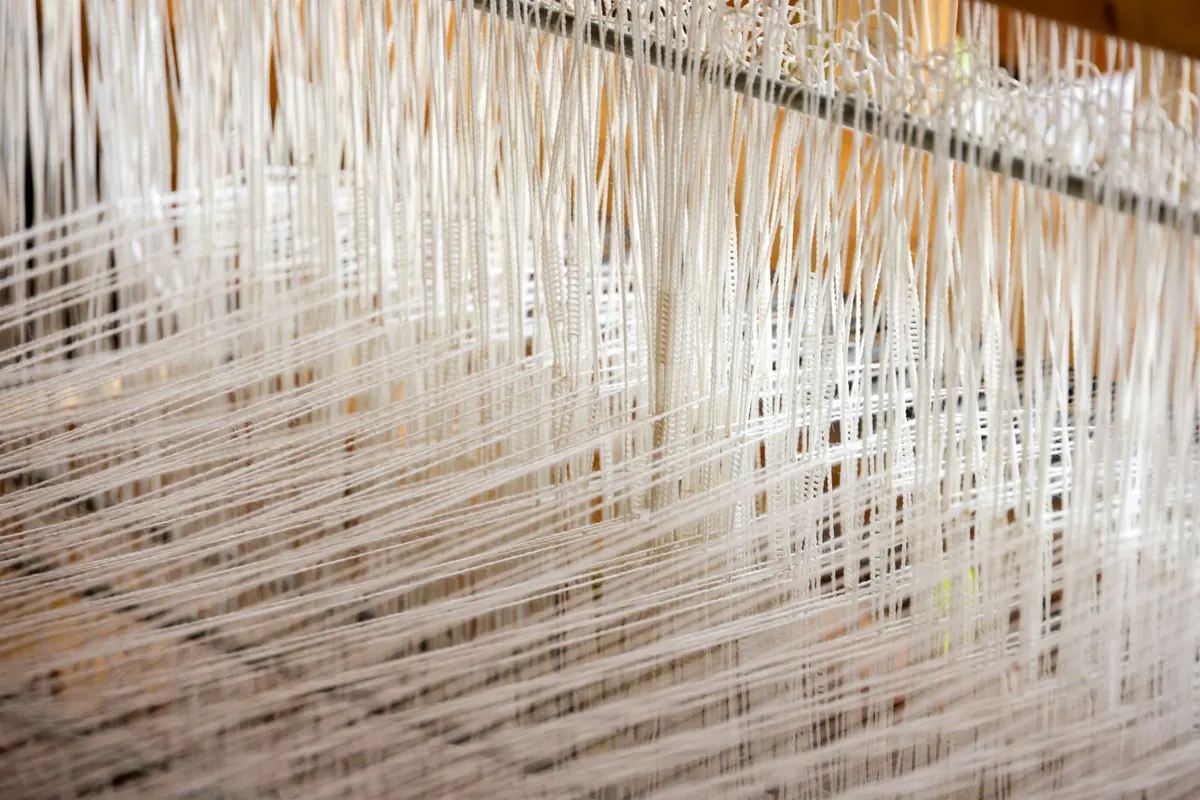
Sett is the number of warp ends per inch (or per centimeter, depending on where you learned) as they sit in the cloth. A warp set at 12 epi has twelve threads in every inch of its width; on a 10-inch-wide warp, that's 120 ends to wind, thread, and sley. The word comes from the old habit of "setting" a warp — deciding its spacing — and it remains the most useful single number in project planning.
Two things get confused with sett, and it's worth separating them now. The first is reed count, the number of dents (the slots between the wires) per inch in your reed. A 12-dent reed and a 12-epi warp are not the same thing, even though one end in every dent of that reed happens to give you 12 epi. The reed is a tool; the sett is the result you're aiming for. The second is picks per inch, the weft count, which you control as you weave rather than when you dress the loom.
EPI, PPI, and Balance
Warp spacing is usually written as EPI — ends per inch. Its counterpart, PPI, counts picks per inch, the weft threads beaten into place. Together they describe the density of the finished cloth in both directions.
When epi and ppi are roughly equal and the warp and weft are the same yarn, you get a balanced plain weave: the threads cross at close to 45 degrees and neither direction dominates. Change either number and the cloth changes character. Push the ppi up while keeping the sett open and the weft covers the warp — a weft-faced fabric, the basis of rugs and tapestries. Set the warp densely and beat gently and you get warp-faced cloth, which is how sturdy bands and ribbons are made.
Here's the practical asymmetry worth remembering: ppi is adjustable at the loom, minute by minute. Epi is fixed the moment the warp is threaded and sleyed. That's why sett deserves the thinking time.
What Sett Does to Cloth
Sett governs coverage, drape, durability, and how the cloth behaves in the wash. It decides whether your scarf folds softly or stands away from the neck, whether a towel absorbs or glazes over, whether a bag holds its shape after a season of use.
The symptoms of a bad sett are easy to read once you know what to look for:
- Too close: the warp feels like a board, the shuttle grumbles through the shed, the reed leaves visible lines, and threads abrade where they cross.
- Too loose: gaps show when you hold the cloth to the light, the weft slips, and cut edges fray into a fringe you didn't plan on.
- About right: threads sit beside each other without crowding, the cloth holds a gentle curve when draped, and your finished sample behaves the way you hoped.
Fiber matters as much as arithmetic. Wool fulls and shrinks in the wash, pulling its threads closer together, so a wool warp is often set more openly than a cotton one of the same thickness. Cotton is comparatively stable. Linen benefits from a slightly looser sett to allow for swelling and to soften its tendency to crack where it bends. Silk will take a closer sett than most beginners expect.
Finding a Starting Sett for Your Yarn
The most reliable starting point is the yarn's own diameter, which you can measure with a ruler and five minutes.
- Hold a ruler upright and wrap the yarn around it for one inch, keeping the wraps touching but not overlapping.
- Count the wraps. That's your wraps per inch, or WPI, a decent stand-in for yarn thickness.
- Take a percentage of the WPI according to your weave structure — roughly 50–60% for plain weave, 60–75% for twill, and 75–90% for satin or other float-heavy structures.
- Round the result to something your reed can actually produce, then sample before committing a full warp.
A yarn that gives you 20 wraps per inch, for example, suggests a plain-weave sett somewhere around 10 to 12 epi. That range is wide on purpose: it leaves room for fiber, finishing, and what you want the cloth to do. A soft scarf can sit at the low end; a tea towel washed every week wants the high end.
Sett charts and other weavers' notes are useful second opinions, especially with standard yarns such as 8/2 cotton. Treat every published number as a proposal rather than a rule — different looms, different beating, and different finishing all shift the result.
From Sett to Reed: Dents and Sleying
Sleying is the act of pulling each warp end through a dent in the reed, and the arithmetic connecting sett to reed is plain division. Sett divided by reed count gives ends per dent.
- 12 epi in a 12-dent reed: one end per dent.
- 20 epi in a 10-dent reed: two ends per dent.
- 18 epi in a 12-dent reed: one and a half — sley a repeating two ends, one end, two ends, one end.
- 8 epi in a 12-dent reed: too few for the reed, so sley one end per dent and skip a dent at regular intervals, or reach for a coarser reed.
Two cautions. Cramming three or more ends into a single dent concentrates them, and several ends per dent in a coarse reed tends to leave reed marks — faint lines running the length of the cloth. And when you sley an uneven pattern, put the doubled dents at the selvedges so the edges stay firm and don't pull in.
Sample, Finish, Then Decide
Numbers take you a long way; finishing takes you the rest. Cut a small sample off the loom, wet-finish it the way you intend to treat the finished piece, dry it flat, and measure again. Wool that fulls can pull in considerably; linen softens and settles.
Note the sett and ppi you used, the yarn, the reed, and how you finished it. A few index cards like this, kept in a box, will do more for your instinct than any chart. Something you wove at 18 epi and loved tells you, later, that you can weave its neighbor
Photo: Magda Ehlers / Pexels